

February 2026 Safety Update: Trazodone Recall; Urgent Recall for CGM Sensors; Non-Statin Pill Lowers LDL; Eye Drops for Presbyopia; Ozempic Tablet; Osteoporosis Drugs; SRI Safety Concerns, More
Granules Pharma Recalls Trazodone 50mg Tablets
Granules Pharmaceuticals is recalling 71,424 bottles (100-count) of 50 mg strength Trazodone Hydrochloride Tablets. Some 25mg strength Metoprolol Succinate ER tablets, bearing the imprints “I” and “25,” were found inside the bottles from batch 6160008A with an expiration date of December 2026. The pills were manufactured by Granules India Limited in Hyderaba India. Trazodone is a selective serotonin reuptake inhibitor (SSRI) approved to treat depression and also often used for insomnia. Metoprolol succinate extended-release is a drug to treat high blood pressure or hypertension.
Link to FDA Enforcement Report
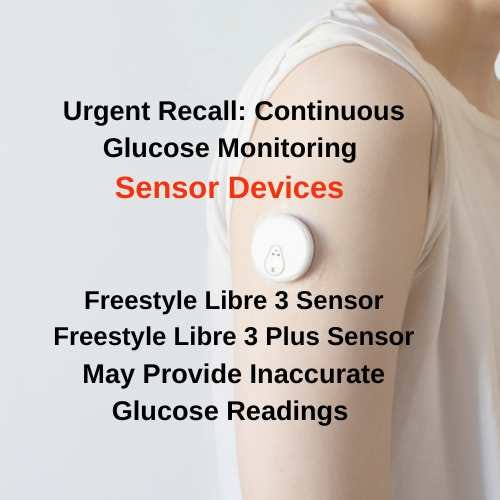
Abbott Recalls Continuous Glucose Monitor Sensors for Freestyle Libre 3 and Libre 3 Plus System
The FDA announced a Class 1 recall (the most serious type) for almost 3 million continuous glucose monitor (CGM) sensors, part of the Freestyle Libre 3 and Libre 3 Plus CGM systems. So far, 860 serious injuries and seven deaths related to these products have been reported. These sensors may give false low glucose warnings, sometimes leading users to skip insulin or increase sugar intake, resulting in life threatening consequences. Until they receive replacement sensors for their CGM systems, patients are urged to use a separate blood glucose meter to measure glucose levels.
During inspections at the Abbott Diabetes Care facility in Alameda, California in in October 2025, FDA found, among other violations, that “contract manufacturers responsible for final assembly and release were not provided accuracy performance specifications and were not required to verify finished-device accuracy performance prior to release.” The enforcement report states that the problem was “due to a manufacturing process issue that may cause carbon build up in the sensor that may result in incorrect low glucose results.”
Recall Information: FDA Press Release and Abbott Diabetes Care Warning Letter
Rybelsus Tablets Rebranded as Ozempic Tablets
Novo Nordisk has rebranded one version (containing 1.5 mg, 4 mg and 9 mg strengths) of its Rybelsus (semaglutide) tablets as Ozempic tablets. Rybelsus-branded pills will still be available in the 3 mg, 7, mg and 14 mg strengths. Rybelsus and Ozempic tablets are approved to treat Type 2 diabetes and to reduce the risk of heart attacks and strokes in high risk Type 2 diabetes patients. The rebranding is convenient for Novo Nordisk, since the tablets were already approved (since 2019) and only a name change was made. Wegovy, approved for weight loss, received supplemental FDA approval for its tablet formulation in December 2025.
Ozempic tablets and Wegovy tablets are available in the same strengths (1.5 mg, 4 mg and 9 mg, with one additional 25 mg strength cleared for Wegovy) and are taken daily.
Reuters: Novo Launches Ozempic Tablets in Second Quarter 2026
FDA: Safety Label Update for Rybelsus
New Cholesterol Drug Fast Tracked for Review
Patients may soon have a pill option for a PCSK9-inhibitor LDL cholesterol-lowering drug. Right now, only “large molecule” PCSK9-inhibitor injectables like Repatha or Praluent are available in this treatment category. The FDA granted Merck a “national priority voucher” for a faster review time of its enlicitide decanoate tablets. If approved, it will be the first oral inhibitor of PCSK9, the protein that limits the liver’s ability to remove bad cholesterol from the blood. Merck also received a priority voucher for its investigational lung cancer drug Sacituzumab Tirumotecan to treat advanced non-small cell lung cancer NSCLC with specific mutations.
FDA Announcement
Pharmacy Times: “FDA Grants National Priority Vouchers to Enlicitide Decanoate, Sacituzumab Tirumotecan
Eye Drops for Age-Related Blurry Vision (Presbyopia) Provides Alternative to Reading Glasses
Visus Therapeutic’s Yuvezzi (carbachol and brimonidine tartrate ophthalmic solution) received FDA approval to treat presbyopia, or age-related farsightedness causing blurry close-up vision in adults. The eye drops are administered once daily, one drop per eye, with effects lasting up to eight hours. Contact lenses can be inserted after using the eye drops, allowing correction of both distance and close-up vision without the need for glasses.
Like previously approved drops for presbyopia, Vizz (approved in 2025) and Vuity and Qlosi (approved in 2022 and 2024), the drops work by constricting the pupils (the pinhole effect) and holding them that way for hours. However, this can cause safety concerns when driving at night or doing other activities in dim light, and patients are warned to use caution when operating machinery or driving in dim light.
FDA: Yuvezzi Drug Label
ZME Science: Finally, a Daily Eye Drop That Could Actually Replace Your Reading Glasses
At-Home Brain Stimulation Treatment Approved For Depression
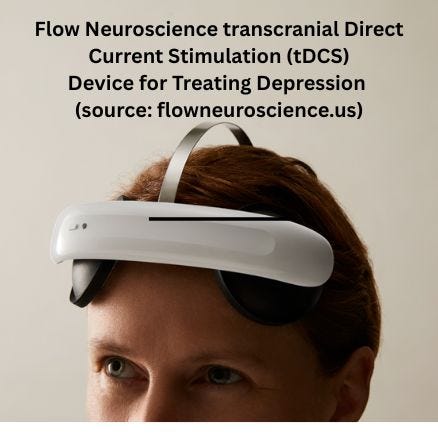
Swedish company Flow Neuroscience received FDA approval for a device that uses transcranial direct current stimulation (tDCS) to relieve depression by delivering electrical current through a headband to stimulate mood-regulating brain regions. Unlike transcranial magnetic stimulation (TMS), which require different equipment and office-based visits, tDCS can be self-administered with app-based guidance and remote monitoring.
The supporting trial, led by researchers at the Institute of Psychiatry, Psychology and Neuroscience, King’s College London and published in Nature, showed that 58% of patients achieved remission from depressive symptoms after 10 weeks while just 29% of placebo patients achieved remission. Like many trials supporting drug approvals, quality long term data on effectiveness is lacking. Scientific American reported that a study published in the Lancet in 2023 found tDCS to be no better than a placebo for treating depression.
Forbes reports that while traditional office-based TMS is covered by commercial insurance and Medicare, tDCS, while much cheaper (expected to cost about $500-$800), has not yet been approved for reimbursement.
Forbes: FDA approves first at-home brain stimulation device for depression
Nature: “Home-based transcranial direct current stimulation treatment for major depressive disorder: a fully remote phase 2 randomized sham-controlled trial
On its U.S. web site, Flow Neuroscience says it expects the devices to be available in the U.S. in summer 2026.
Also see: Brainsway TMS Device Approved to Treat Adolescents Age 15-21
Osteoporosis Drug Safety
The condition of osteoporosis is diagnosed based on the results of a bone density scan, a low-dose x-ray which measures calcium and other minerals in the bones. If the results indicate a person has low bone density or osteoporosis, deciding on treatment options can be complicated. Most prescription treatment options come with risks of serious side effects. On the Ask a Patient website, some patients have reported debilitating side effects from “bisphosphonate” drugs like alendronate (Fosamax brand name) including severe jaw pain, loss of bone in the jaw (osteonecrosis), stress fractures, and more.
If you are about to start a new osteoporosis drug or want to learn more about treatments, check out MedShadow’s recent article, “The Complicated Reality of Treating Osteoporosis,” a comprehensive guide to bone density and osteoporosis-related conditions, the types of treatments (including non-drug approaches), and safety concerns.
The FDA recently posted safety-related labeling updates for six osteoporosis “bisphosphonate” treatments. The labels now warn of the risk of atypical fractures (those that occur with minimal or no trauma to the affected bone) that occur not just in the femur but in other bones in the body. “Prodromal” pain in the affected area, usually presenting as dull, aching pain, occurs weeks to months before a complete fracture occurs. Safety updates are added for: Actonel, Atelvia, Binosto, Fosamax, Fosamax Plus D, and Reclast.
Links to patient reviews at Ask a Patient: Bisphosphonates Drugs
Read more about bone density scans at Medline Plus
Public Citizen Petitions FDA to Add Pregnancy Warnings on Antidepressant Labels
Many in the medical community, including the American College of Obstetricians and Gynecologists (ACOG), issued statements of alarm in reaction to the July 2025 FDA committee meeting convened to consider strengthening or adding warnings about the use of antidepressants SSRIs (Selective Serotonin Reuptake Inhibitors like Celexa and Prozac) and SNRIs (Serotonin-Norepinephrine Reuptake Inhibitors) like Effexor and Pristiq) during pregnancy. ACOG maintains that SSRI antidepressants are safe, necessary, and even lifesaving during pregnancy for many women with depression.
So far, the FDA has not requested any related changes to the drug labels. But consumer advocacy group Public Citizen recently filed a petition with the FDA urging the agency to require balanced, evidence-based pregnancy warnings in the product labels of serotonin reuptake inhibitor (SRI) antidepressants, which include SSRIs and SNRIs. In their letter, they cite research evidence of postnatal withdrawal symptoms (PNAS) in newborns who are exposed to SRIs in the third trimester of pregnancy.
“PNAS manifests as a constellation of variable transient cardiovascular, respiratory, central nervous system, gastrointestinal or motor adverse reactions. Specific signs include breathing problems, feeding difficulty, vomiting, low blood sugar levels, irritability, constant crying, temperature instability or seizures.”
The petition also requests adding a new warning about avoiding concomitant use of SRIs with benzodiazepines (sedative drugs like diazepam) or other central nervous system depressants in the third trimester of pregnancy because it can exacerbate PNAS in newborns.
Worst Pills, Best Pills February 2026 Newsletter: “Public Citizen Petitions FDA To Improve Pregnancy Warnings for Common Antidepressants” (Article is paywalled; abstract is available)
Public Citizen Press Release: Public-citizen-petitions-the-fda-to-require-updated-pregnancy-warnings-for-serotonin-reuptake-inhibitors
Pet Medication News
Check out our special post on pet medications news, featuring a new drug approval for idiopathic epilepsy in dogs, a new treatment for a type of cancer in dogs, a warning about a human drug that is toxic to pets, and an investigational medication that aims to extend the lifespan of dogs.

Did you miss the last edition? Check it out here:
