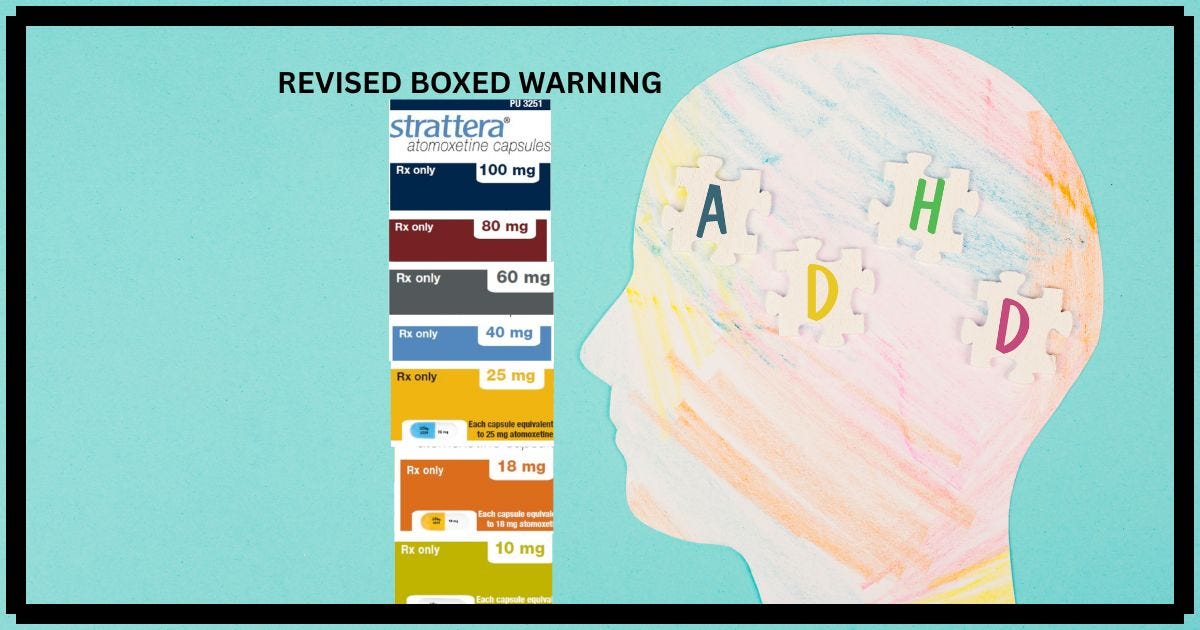
Eli Lilly recently revised the label for its non-stimulant ADHD (Attention-Deficit Hyperactivity Disorder) drug Strattera (atomoxetine hydrochloride) to clarify the boxed warning and age indications and to make other required formatting changes. If you’re taking generic Strattera, or atomoxetine capsules, no need to worry about newly discovered side effects with this update; the revisions include only editorial changes that aim to better organize the information and add clarity to the label and Patient Medication Guide.
First Boxed Warning Revision for Strattera (Atomoxetine) In 20 Years
The most noticeable effect of the label change is that by removing technical language about clinical trials from the boxed warning, it strengthens and clarifies the warning about the risk of suicidal thoughts and behaviors in pediatric patients age 6 and older. However, it does not address the possible increased risk of suicidal thoughts in adults, even though that uncommon effect has been reported in many post-marketing reports and was statistically significant in clinical trials for another nonstimulant ADHD product, Qelbree (viloxazine). Atoncy, the oral solution formulation of atomoxetine, has the same boxed warning as Strattera and generics. Strattera became available as a generic in 2017 and brand name Strattera was discontinued from the market in 2023, but not due to safety or efficacy reasons.
A boxed warning is the strongest warning that the FDA requires, and signals that the drug carries a significant risk of serious or even life threatening side effects. Strattera did not have a boxed warning about suicidal ideation when it was initially approved in 2002. By September 2005, with more clinical trials completed, the Food and Drug Administration (FDA) issued a Public Health Advisory entitled “Suicidal Thinking in Children and Adolescents Being Treated with Strattera (Atomoxetine)” on September 29, 2005. At the FDA’s request, in November 2005 Lilly added a black box warning to the label. It stated the mean incidence of suicidal ideation in pediatric clinical trials was .4%, and all events occurred during the first month of Strattera treatment. Here is the original boxed warning:
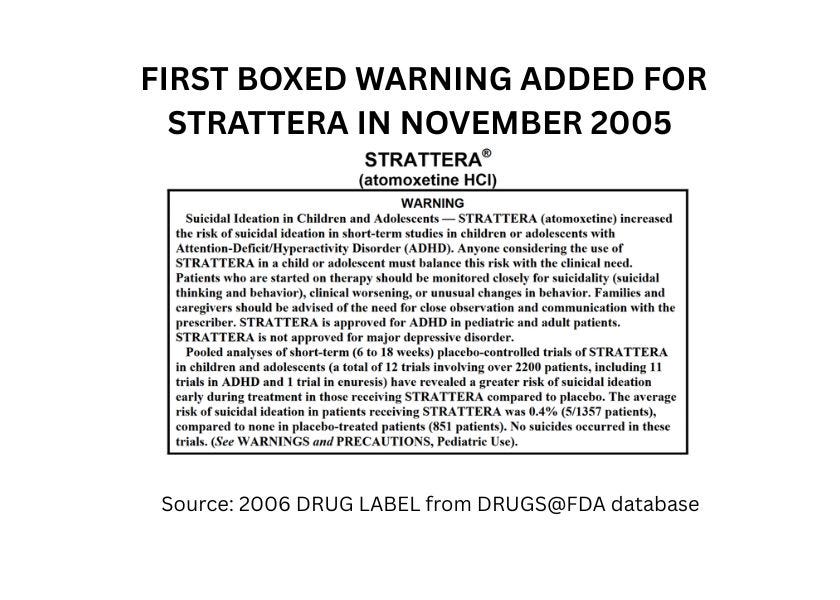
Note that the warning with its technical language, is more likely to be skipped over; it emphasizes that no suicides actually occurred.
In June 2026, the FDA approved Strattera’s supplemental approval for the latest label change. The boxed warning now appears as follows:
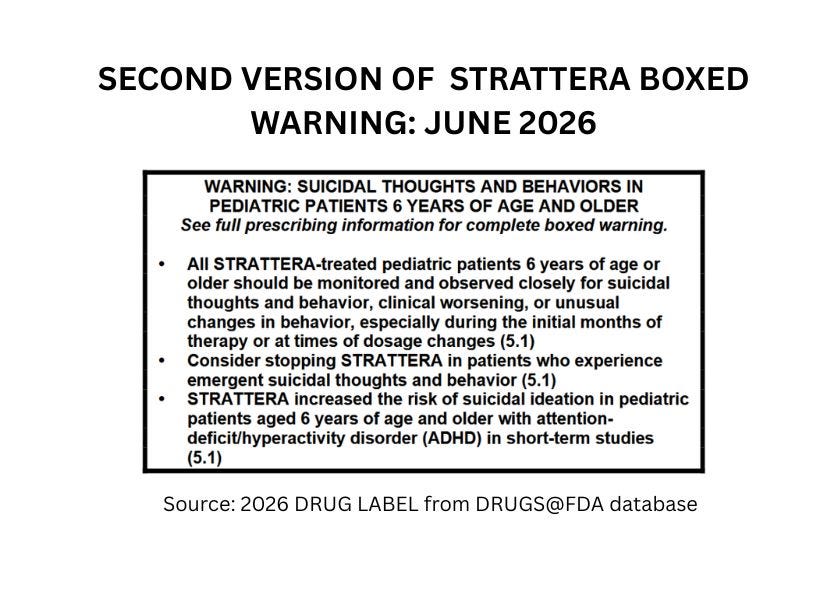
Note that the revised warning is in a bigger typeface, is shorter, and more to the point. The clinical trials results and additional discussion are moved to the appropriate section of the drug label. However, it states “See full prescribing information for complete boxed warning” and when you scroll down the label to the “complete” boxed warning, it contains the exact same wording as the boxed warning at the top, but without the “See full prescribing information…” at the top of the box. Readers should click to the label’s linked section (5.1) to find more information about the warnings.
Suicidal Thoughts Risk is Controversial
The boxed warning and the drug’s link to suicidal ideation is controversial. A University of Florida (UF) 2016 review found no significant association with increased risk of suicidal ideation with atomoxetine compared to stimulant medications.
Of the 300,000 children UF researchers studied using atomoxetine or stimulants as a first-line treatment, 140 suicide events were observed. For the 220,000 patients taking atomoxetine as a second treatment option, 90 suicide events were observed. UF researchers found no statistical significance in these results that suggested atomoxetine increased the risk of suicidal events compared with stimulants.
UF Press release: “UF researchers find ADHD drug does not heighten suicide risk despite FDA warning“
Post-Approval Reports of Suicidal Ideation
Nevertheless, the FDA’s Adverse Events database System (now called the Adverse Events Monitoring System or AEMS) has received a higher percentage of total reports for suicidal ideation with atomoxetine compared with the reports of suicidal ideation involving stimulant ADHD drugs. Suicidal ideation is the 12th most common adverse event reported for Strattera, with 922 reports (see chart below) received globally; primarily reported by drug sponsors (Eli Lilly).
Here is a summary of frequently reported effects in over 20,000 FDA adverse event reports (for all ages) involving Strattera brand name received between 2004 and April 2026, taken from Ask a Patient’s FDA Adverse Events Report Summary:
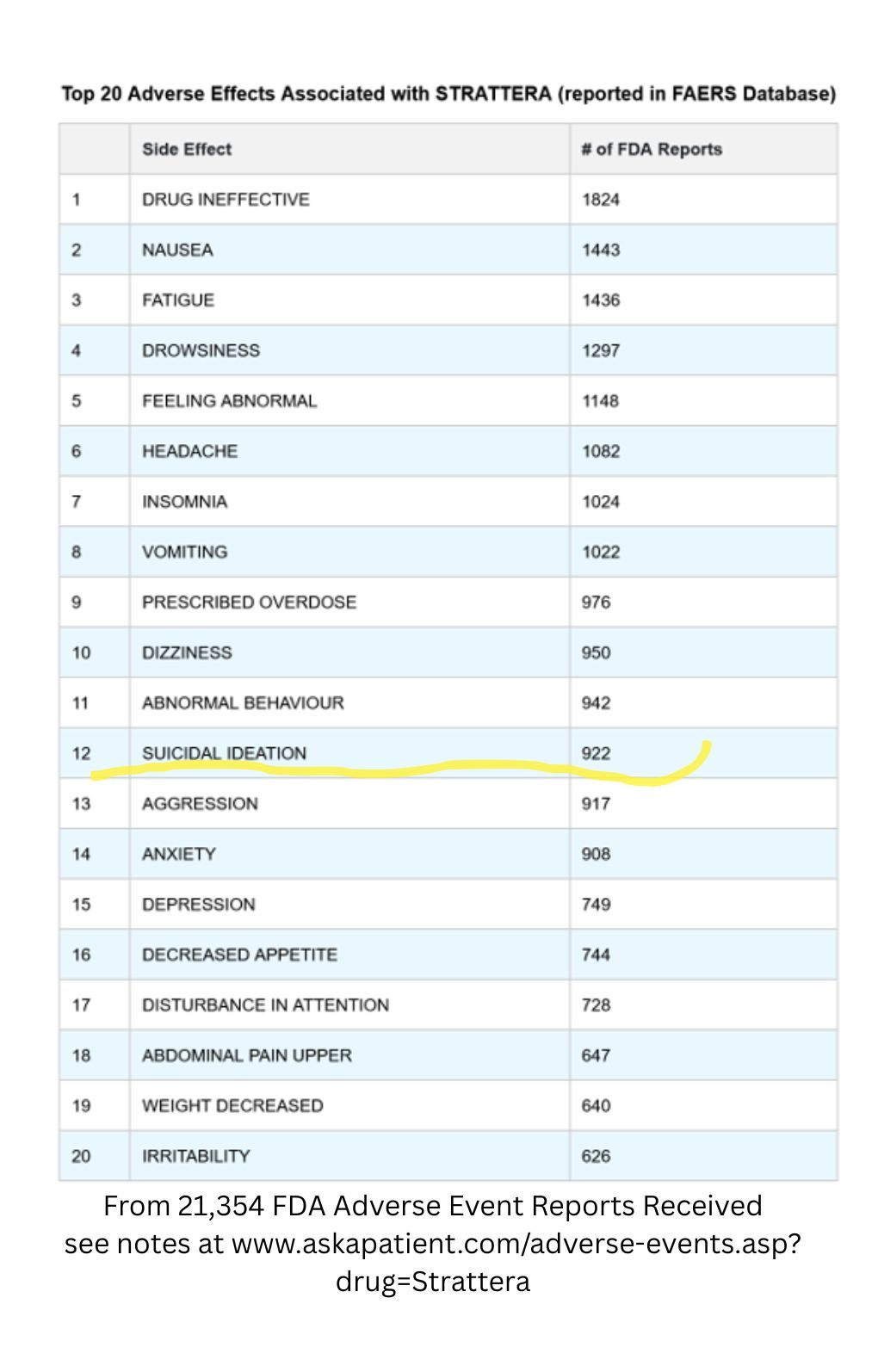
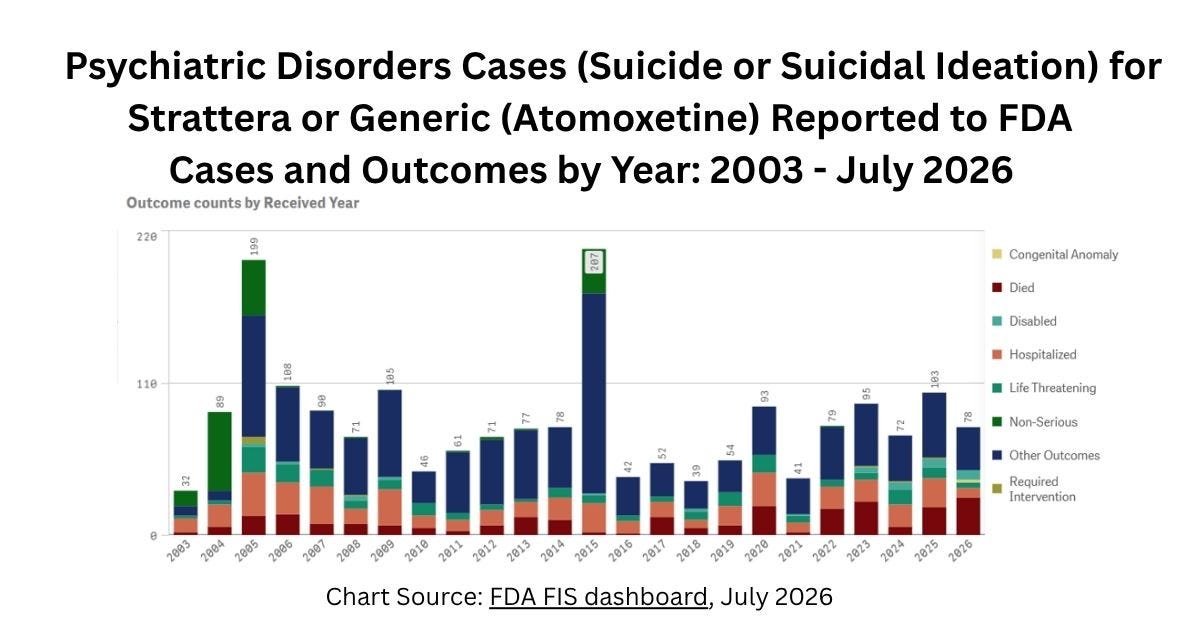
A subset of the above report, which includes 620 direct reports submitted by U.S. consumers and healthcare providers directly through the MedWatch reporting system, reveals 34 cases (the 7th most common event for all ages) of suicidal ideation. You may also do a fine tuned search of the FDA reports using the FDA FIS dashboard. Note that there can be some (usually small) differences in case numbers using FDA FIS dashboard vs Open FDA vs. quarterly download reports of FDA AEMS data.
Below is a chart compiled using the FDA FIS dashboard showing counts of suicidal ideation or related cases, along with outcomes, for all ages reported between 2003 and July 2026 for Strattera brand name and generics. A look at the count of reports by age of patient show over 600 suicidal-related reports for adults and more than 260 reports where the age was not reported. There is a jump in reported cases in 2005 and 2015; we haven’t been able to determine what caused those increases.
The greater prevalence of suicidal reports for atomoxetine rather than stimulants is echoed by reviews at the Ask a Patient site: 19/445 Strattera reviewers reported suicidal thoughts, while 4/885 had this reaction for the ADHD stimulant drug Adderall, and only 3/214 had the reaction for stimulant Ritalin and 10/642 reported the reaction for ADHD stimulant medication Vyvanse .
Where is the Warning or Clinical Study Data for Adults?
Nowhere on the label for Strattera is there a mention or explanation of the suicidal ideation risk for adults, as measured in either clinical trials of adults or that have been reviewed as FDA post-approval case reports. It is surprising that almost 25 years after approval, the disclosure hasn’t been been added, at a minimum, to the Post-Marketing Experience section of the label.
New Side Effects Added Over the Years
There have been other side effects that the FDA requested as additions to the label over the years, including “risks of aggression and manic symptoms in all age groups” and the associated “screening for bipolar disorder“ in January 2022, aggressive behavior (2022), risk of alopecia” (hair loss) in March 2017, risk of “rhabdomyolysis” (where muscle tissue breaks down and releases harmful substances into the bloodstream) in 2015, “libido changes” in 2013, “Increase in blood pressure and heart rate” in 2012, contraindicated in patients with pheochromocytoma (adrenal gland tumor) in 2011, “Effects on Growth sub-section” in 2005, and others.
Strattera is being studied along with another ADHD Norepinephrine reuptake inhibitor (NRI) treatment Qelbree (approved in 2021) for potential signs of Withdrawal Syndrome: FDA Adverse Event Monitoring System AEMS January to March 2024 Quarterly Report of New Safety Information or Potential Signals of Serious Risks. Qelbree’s label also has a boxed warning for the risk of suicidal ideation, but the warning is directed at all patients, not just pediatric patients.
Additional Sources and More Reading:
June 2026 Safety Labeling Change for Strattera
Supplemental approval Letter from FDA in June 2026 approving the label updates.
Updated Strattera label
NOREPINEPHRINE REUPTAKE INHIBITORS list at Ask a Patient
Qelbree Patient Reviews
Strattera patient reviews at Ask a Patient
Psychiatry Online, October 21, 2005: “Lilly Agrees to Add Warning on Strattera Labeling”